A few weeks ago, I had the opportunity to travel to Washington, DC, for a leadership workshop focused on preparing future provosts. The workshop itself was excellent. I learned a lot, met some really good people from around the country, and came home with plenty of ideas to think about. But let's be honest...that's only half the story.
If you know me, you know I'm not going to spend my evenings sitting in a hotel room watching TV. I had a few free hours each night, so I did what I usually do when I visit a new place. I started walking. Washington, DC, is one of those cities where history isn't hidden away behind museum walls. It's everywhere. Around nearly every corner is another memorial, another statue, or another building that played a role in shaping our country.
Over two evenings, I walked several miles through the National Mall and around the Tidal Basin. I saw some of America's most recognizable landmarks and stumbled across quite a few places I never expected to find.
Tuesday Evening: Walking the National Mall
After the first day of the workshop, I headed toward the National Mall.
The first thing that really stopped me in my tracks was the Washington Monument. You see pictures of it your whole life, but standing underneath it is a completely different experience. Built to honor George Washington, the monument stands 555 feet tall and is still the tallest stone obelisk in the world. One thing I learned while I was there is that construction actually stopped for more than twenty years because of funding issues and the Civil War. When work finally resumed, they had to use marble from a different quarry, so if you look closely, you can actually see where the stone changes color. I love little details like that.

From there, I made my way west toward the Lincoln Memorial, stopping whenever something caught my eye. One of those stops was the National World War I Memorial and Pershing Park. More than four million Americans served during World War I, yet it often gets overlooked compared to World War II. The memorial does a wonderful job of telling the story of ordinary people who answered the call to serve. The sculpture, A Soldier's Journey, is especially impressive and worth taking a few minutes to study.

Nearby sits the District of Columbia War Memorial. It's much smaller than many of the surrounding memorials, and I imagine a lot of people walk right past it. It honors the men and women from Washington, DC, who served during World War I, and I appreciated that it gave recognition to the local community's sacrifice. Eventually, I reached the Lincoln Memorial.
There really isn't much I can say that hasn't already been said about it. It's every bit as impressive as you'd imagine. Dedicated in 1922, it honors Abraham Lincoln and his leadership during the Civil War. Inside, Lincoln's Gettysburg Address and Second Inaugural Address are carved into the walls, reminding visitors of both the cost of preserving the Union and the hope of reconciliation. Standing on those famous steps and looking back across the Reflecting Pool toward the Washington Monument is one of those views that almost doesn't seem real because you've seen it so many times in photographs. Of course, it's also the place where Dr. Martin Luther King Jr. delivered his "I Have a Dream" speech, making it one of the most significant locations in American history.
Just down the path is the Vietnam Veterans Memorial. Unlike many monuments that celebrate victories or leaders, this one feels deeply personal. The polished black granite wall bears the names of more than 58,000 Americans who were killed or remain missing from the Vietnam War. Watching people quietly trace names with their hands or leave flowers and flags was incredibly moving. It reminded me that for many visitors, this isn't just history. It's family.
A short walk away is the Korean War Veterans Memorial, another place that left a lasting impression. Nineteen stainless steel soldiers move cautiously through a field of juniper, representing troops from every branch of the military. Their expressions are serious, almost haunting, and the famous inscription, "Freedom Is Not Free," seems to capture the entire purpose of the memorial in four simple words. By the time I headed back to the hotel that night, my feet were definitely feeling it. But I also knew I'd barely scratched the surface of everything there was to see.
Wednesday Evening: Around the Tidal Basin
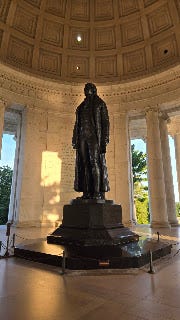
The next evening, I headed in a completely different direction and walked around the Tidal Basin. If I had to pick one favorite place from the entire trip, it would probably be the Jefferson Memorial. Maybe it was the location overlooking the water. Maybe it was because it felt a little quieter than the other memorials. Whatever the reason, I found myself taking more photos and in awe. The memorial honors Thomas Jefferson, the principal author of the Declaration of Independence and our nation's third president. Inside is a massive bronze statue surrounded by excerpts from Jefferson's writings about liberty, education, and self-government.I sat there for a while just reading the inscriptions and taking in the view. It was one of those places that encourages you to stay a little longer.
Not far away is the George Mason Memorial. I'll admit, before this trip I didn't know as much about George Mason as I probably should have. Mason wrote the Virginia Declaration of Rights, which heavily influenced the Bill of Rights. Interestingly, he refused to sign the U.S. Constitution because it didn't include protections for individual liberties. Many of the freedoms we enjoy today can be traced back to his insistence that those rights be protected.
From there I continued to the Franklin Delano Roosevelt Memorial. Instead of one large monument, the memorial unfolds as a series of outdoor spaces representing Roosevelt's four terms as president. Waterfalls, sculptures, and quotations tell the story of the Great Depression, the New Deal, and World War II. One of the things I appreciated most was that it didn't try to simplify history. It acknowledged both the struggles the country faced and the complicated challenges Roosevelt navigated during one of America's most difficult eras.
My final major stop of the evening was the Martin Luther King Jr. Memorial. The centerpiece, known as the Stone of Hope, is carved from granite and inspired by a line from King's famous "I Have a Dream" speech. Surrounding the memorial are quotations from his speeches and writings that continue to challenge visitors decades after they were first spoken. Like the Jefferson Memorial, this was another place where people weren't rushing. Most were simply standing quietly, reading, and reflecting.
The Things I Never Planned to See
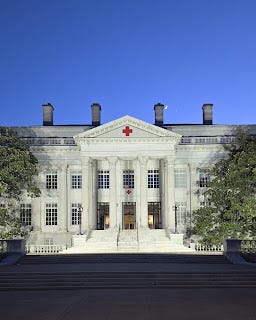
Some of my favorite moments weren't on my itinerary at all. Walking around Washington means constantly running into history when you least expect it. I wandered past the Lockkeeper's House, the oldest remaining building on the National Mall. Built in 1837, it once served the Chesapeake and Ohio Canal, long before the Mall became what we know today. I caught a glimpse of the White House, although much of it was blocked off during my visit. Even so, it's hard not to pause for a moment when you're standing outside the home of every president since John Adams. I also found myself admiring the beautiful headquarters of the Organization of American States and the historic American Red Cross building.
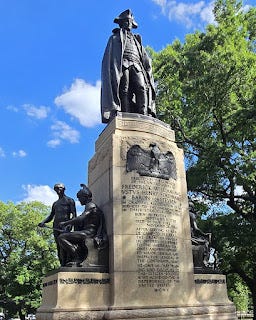
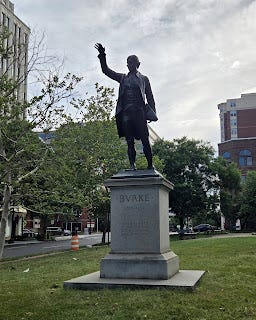
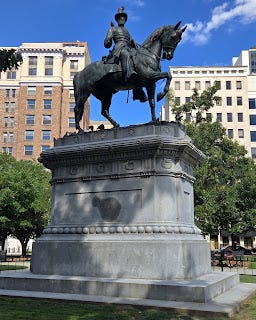
One thing you'll probably notice from the photos is that I became a little obsessed with the statues around Washington. Every few blocks I'd find another historical figure I knew a little about, or sometimes nothing at all. More than once I found myself stopping to read the plaque, pulling out my phone to learn a little more, and walking away with a new appreciation for someone I'd never really thought about before. John Paul Jones. Commodore John Barry. General McPherson. Baron von Steuben. Tadeusz Kościuszko. Edmund Burke. The Thomas Circle Memorial. Everywhere I turned seemed to be another reminder that history isn't built by just a handful of famous names. It's shaped by thousands of people whose stories deserve to be remembered. Those unexpected discoveries may have been my favorite part of the trip.
Final Thoughts
I came to Washington for a workshop. I left with a renewed appreciation for American history. There's something different about standing where history happened. Reading Lincoln's words inside the memorial. Walking alongside the Vietnam Wall. Sitting quietly at the Jefferson Memorial as the sun begins to set. Those experiences stay with you in a way that reading a book never quite can. I'm sure there are still plenty of things I missed, which just gives me another reason to go back someday.
Until then, I'll keep doing what I love most when I visit somewhere new. Find a good pair of walking shoes, pick a direction, and see what I discover.
Thanks for coming along on another adventure. If you'd like to see more photos from this trip, along with plenty of hiking, fishing, road trips, and the occasional great meal, you can find me on Instagram @mikeisoutside