

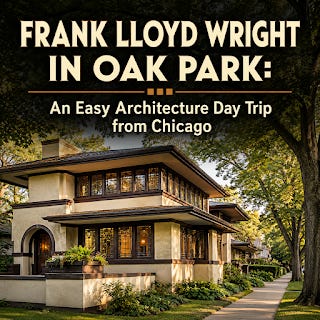
During my recent trip to Chicago, some of the most interesting architecture I encountered was not among the skyscrapers downtown. It was a short train ride west in Oak Park, Illinois, where Frank Lloyd Wright lived, worked, and developed ideas that would help transform American architecture.
I made the trip to tour the Frank Lloyd Wright Home and Studio, then spent time walking through the surrounding historic district. I also found a quiet little park nearby that offered a nice break between all the architecture. Together, the three stops made Oak Park one of the most memorable parts of my visit to the Chicago area.
Touring the Frank Lloyd Wright Home and Studio
Frank Lloyd Wright built his Oak Park home in 1889 and used it as both a family residence and a place to test architectural ideas. In 1898, he added the adjoining studio, where Wright and his team created work that helped establish the distinctly American Prairie style.
The guided tour offered by the Frank Lloyd Wright Trust takes visitors through the home’s family spaces, library, drafting room, and studio. It was fascinating to see how Wright experimented with light, space, materials, furniture, and decorative details throughout the property.
The home does not feel like a static display of architectural history. It feels more like an architectural laboratory. Wright was testing ideas in the same place where he and his family lived, sometimes challenging basic assumptions about how rooms should be arranged and how people should move through a house.
Some features were beautiful. Others were unusual enough to make me stop and think about what he was trying to accomplish. That was one of the best parts of the tour. It did not simply present Wright as a famous name. It showed an architect working through ideas, taking chances, and gradually developing a style that would influence buildings far beyond Oak Park.
The adjoining studio adds another layer to the visit. The drafting room, library, and working spaces make it easier to imagine Wright and his team producing designs there. The tour connects the professional work taking place in the studio with the experimentation visible throughout the family home.
For anyone interested in Wright, historic homes, or American architecture, the tour is worth the trip from Chicago. Even people who do not know much about Prairie School architecture can come away with a better understanding of what made Wright’s work so different.
Walking the Frank Lloyd Wright Historic District
After touring the Home and Studio, I explored the surrounding Frank Lloyd Wright Historic District using the Trust’s self-guided audio walking tour. Oak Park has the largest concentration of Wright-designed buildings in the world, so the neighborhood is not just a setting for the Home and Studio. It is an important part of the experience.
The audio tour shares the stories behind Wright-designed homes along the route and points out details that helped shape his Prairie style. Seeing the houses together made it easier to recognize recurring elements, including strong horizontal lines, broad rooflines, bands of windows, sheltered entrances, and designs that seem connected to the land around them.
Walking the neighborhood also reveals how Wright’s ideas developed across different projects. Individual houses may look very different from one another, but certain patterns begin to emerge as the tour continues. It is one thing to read about an architectural movement. It is another to see it unfolding house by house along a few residential streets.
The homes along the route are privately owned. Visitors should enjoy and photograph the architecture respectfully from the public sidewalks. Fortunately, there is plenty to see without intruding on anyone’s property.
I would recommend the audio tour even for visitors who have already completed the guided Home and Studio tour. The two experiences complement one another. The guided tour provides a close look at Wright’s personal and professional spaces, while the walking tour shows how his ideas appeared across the larger neighborhood.
A Quiet Stop at Austin Gardens
Near the Home and Studio, I came across Austin Gardens, a small urban woodland managed by the Park District of Oak Park. After concentrating on historic homes and architectural details, its wooded paths and wildflowers offered a peaceful change of pace.
Henry W. Austin Jr. donated the land to the Park District of Oak Park in 1947 with the condition that it remain a public park bearing the Austin family name. Today, it feels like a pocket of woodland tucked into the middle of the village.
Austin Gardens is not a large park, and it does not require a long visit. That is part of what makes it such an easy addition to an Oak Park day trip. It is close to the main architectural attractions and provides a quiet place to walk, take a few photographs, or simply slow down before continuing through the neighborhood.
Planning an Oak Park Architecture Day Trip
The Frank Lloyd Wright Home and Studio is located at 951 Chicago Avenue in Oak Park, Illinois. From downtown Chicago, take the westbound CTA Green Line to the Oak Park stop. The Home and Studio is about a 15- to 20-minute walk north of the station.
Austin Gardens is located nearby at 167 Forest Avenue. Because the park, Home and Studio, and historic district are close together, they can easily be combined into one walking itinerary.
I would plan enough time for the guided tour, the self-guided neighborhood walk, photographs, and a relaxed stop at Austin Gardens. Comfortable walking shoes are a good idea, especially if you take the train and explore the district on foot. Tour schedules and ticket availability can change, so check with the Frank Lloyd Wright Trust before making the trip.
Is Oak Park Worth the Trip from Chicago?
For anyone interested in Frank Lloyd Wright, Prairie School architecture, historic homes, or walkable neighborhoods, the answer is yes. Oak Park is easy to reach from downtown Chicago, but it feels very different from the city’s riverfront towers and crowded attractions.
My Chicago architecture cruise showed me how architects shaped a major city skyline. Oak Park offered something more intimate. It allowed me to walk through the home where Wright tested his ideas, stand inside the studio where those ideas became professional work, and then see how they spread through the surrounding neighborhood.
That combination made Oak Park more than a side trip. It became one of the highlights of my time in the Chicago area and a place I would recommend to anyone interested in seeing where a distinctly American architectural style began to take shape.