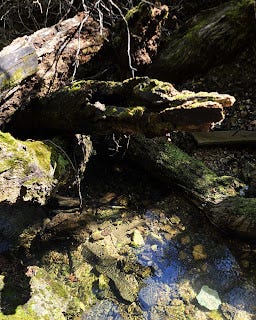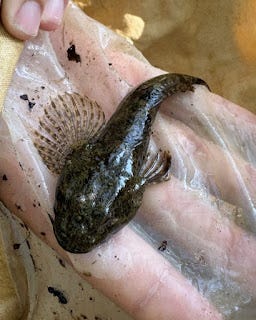
On a regular ol' Monday, I headed toward Huntsville, Arkansas, to spend the day at the McIlroy Wildlife Management Area as part of my service with the Arkansas Game and Fish Commission’s Administrators of Conservation Education program. By the time I made it home, though, the trip had turned into a pretty good example of what we would spend much of the day talking about.
There was an old Civilian Conservation Corps camp on the way in. There was water testing, stream work, caves, bats, conservation education, and some pretty serious conversations at McIlroy. Then there was one more stop at an Arkansas state park on the way home. Not a bad way to spend a Monday.
Starting the Day at Ozone Recreation Area
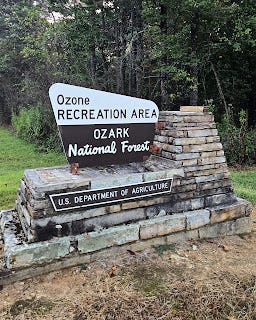
On the way to Huntsville, I made a stop at the Ozone Recreation Area in the Ozark-St. Francis National Forests. Ozone is one of those places that is easy to drive right past if you are not looking for it. Today it serves as a campground and recreation area, but it is also the site of a former Civilian Conservation Corps camp. The CCC played an important role in developing and improving public lands across Arkansas and the country during the 1930s, and some of that history is still visible at Ozone.
I did not spend a huge amount of time there, but that really was not the point. Places like Ozone are a reminder that many of the public lands we enjoy today did not just happen. People built them, improved them, managed them, protected them, and continued taking care of them long after the original work was done.
That seemed like a pretty appropriate way to start a day focused on conservation.
A Day at McIlroy Wildlife Management Area
From Ozone, I continued north toward Huntsville and the McIlroy Wildlife Management Area for our Administrators of Conservation Education meeting. The ACE program brings administrators from around Arkansas together with the Arkansas Game and Fish Commission’s Education Division to explore conservation, environmental education, outdoor recreation, and ways we can create more opportunities for students to connect with the natural world. The current group includes administrators from both K-12 and postsecondary education.
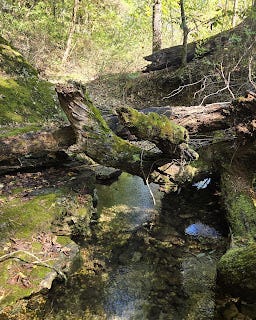
At McIlroy, we got to do some of the learning ourselves. We worked through Stream Team activities and water testing. We talked about Arkansas caves, bats, and white-nose syndrome. We also spent time with some of the simulation and educational tools AGFC uses to help students better understand caves, wildlife, water quality, ecosystems, and conservation. And, yes, part of my workday involved standing in a stream.
I am not going to complain about that. McIlroy itself is a pretty impressive setting for those conversations. The wildlife management area covers more than 15,000 acres north of Huntsville, giving AGFC a real-world setting for wildlife management, habitat work, and conservation.
There is also something different about learning when you actually put the equipment in someone's hands. You can talk about water quality in a classroom. You can show slides about watersheds, caves, wildlife disease, habitat, and ecosystems. But collecting a sample, testing it, looking at the results, and figuring out what those results actually mean is different. The same thing happens when students walk through a habitat, interact with a simulation, examine something they have only read about, or talk directly with someone whose job involves managing natural resources. It becomes real.
Getting Students Outside
Some of the more serious conversations during the day focused on the Generation Conservation Summit and a bigger question: How do we create more meaningful outdoor learning opportunities for students at every level of education? I think that is a conversation worth having. Outdoor learning should not just be treated as a field trip, a reward, or a break from the "real" learning taking place inside a classroom. The outdoors can be the classroom.
Students can collect data from a stream. They can study wildlife habitat. They can learn about geology and caves. They can look at how recreation affects natural resources. They can see how biology, chemistry, environmental science, public policy, tourism, recreation, and land management all run into one another.
More importantly, they can start asking questions.
Why does this stream look different from another one?
What is happening upstream?
Why are certain wildlife populations changing?
What happens when something like white-nose syndrome affects a wildlife population?
Who manages these places?
Who decides how they are used?
What responsibility do the rest of us have for them?
Those are good questions for a fifth grader. They are also good questions for a college student.
AGFC has been putting quite a bit of effort into expanding this kind of conservation and outdoor education across Arkansas, including Stream Team, Generation Conservation, conservation leadership programs, and other field-based educational opportunities.
This Matters in Higher Education, Too
Much of my life is spent in higher education, so I naturally look at these conversations through that lens. Hands-on education should not stop when a student graduates from high school. College students need experiences that allow them to take what they are learning and actually do something with it. They need opportunities to work with professionals, collect data, conduct research, visit organizations, solve real problems, and see how what they are studying connects to careers and communities.
Part of what we should be doing in higher education is making sure students get those experiences as they progress through school and begin building the foundation for whatever comes next. And that takes more than good courses. It takes relationships. Faculty and administrators have to keep building connections with the people and organizations doing the work in the field. We need to know what they are seeing, what problems they are trying to solve, and what they need from the people who will eventually enter their professions.
Those relationships can turn into internships, research projects, field experiences, guest speakers, partnerships, career opportunities, or sometimes just a much better conversation with a student who is trying to figure out what he or she wants to do next. This is part of how we connect education to life after school.
One More Stop at Withrow Springs State Park
After leaving McIlroy, I made one more stop before heading home. Withrow Springs State Park is just outside Huntsville, and I had enough time to walk around the spring, take a few pictures, and spend a little time on one of the trails. It is not one of Arkansas's largest state parks, and I did not have nearly enough time to really explore it. But that was okay.
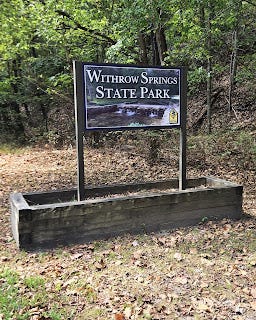
After spending much of the day talking about getting students outside and helping people develop a connection with the places around them, it seemed appropriate to end the trip by doing exactly that myself. Sometimes you do not need a major expedition. Sometimes you stop, walk a trail for a little while, look around, take a few pictures, and then get back on the road. That counts, too.
Public Lands, Conservation, and Education
Looking back at the whole day, the three stops fit together better than I planned. At Ozone, I got a glimpse of the history behind the development and stewardship of our public lands. At McIlroy, I spent the day with educators and conservation professionals talking about how we help the next generation understand those lands, the wildlife that depend on them, and the natural resources around us.
At Withrow Springs, I simply got to enjoy one of those places. There is a connection there. Conservation education is certainly about teaching students about wildlife, water, habitat, and natural resources. But I think it is bigger than that. It teaches students to pay attention. To ask questions. To collect information. To solve problems. To understand that complicated issues rarely have simple answers.
And, especially for students in Arkansas, it gives them a better understanding of the state around them. Not every student who tests water in a stream or learns about wildlife management is going to become a wildlife biologist, conservation officer, environmental scientist, park professional, or land manager. That is not really the point.
For some students, though, an experience like that may introduce them to a career they did not know existed. For others, maybe it simply gives them a little more understanding of the places they live, recreate, hunt, fish, hike, paddle, or visit with their families. Both matter.
I am grateful for the opportunity to serve in the Arkansas Game and Fish Commission’s Administrators of Conservation Education program and to spend time learning alongside educators, administrators, and conservation professionals from around Arkansas. There is a lot we can teach inside a classroom. There are also some things that make a lot more sense once you put on a pair of boots and go see them for yourself.